

Osmoze, by Heavenize
Combining data, calculations and language
in a single architecture.
The portfolio manager's Front Office cockpit, all the way into Excel.
Excel on the surface, server at the core.
Why Osmoze?
Most PMSs on the market were designed for the Middle and Back Office. The Front Office is often treated as a secondary user.
The result: portfolio managers work around their PMS with dozens of uncontrolled Excel files. A significant share of their day is spent on manual reconciliations, copy-paste and checks. Business expertise stays trapped inside individual files, never capitalised on.
Osmoze starts from the opposite premise: a tool adopted by the Front must be designed from the Front. We build Osmoze by sitting next to portfolio managers, not behind a list of requirements.
A portfolio manager's day
with Osmoze
Four everyday actions, in a single cockpit, before diving into the detailed capabilities.
Monitor
The portfolio manager opens the cockpit: consolidated positions, exposures, cash, compliance alerts, up to the second, across all portfolios. No waiting for a Middle Office extract, no manual reconciliation.
Understand
From an aggregated figure, they trace back to the calculation, then to the contributing positions with their valuation. One mouse hover away. No ticket, no export, no intermediary.
Simulate
Before placing an order, they test the impact on cash, risk, compliance and target allocation, in seconds, on real-time consolidated data.
Decide
They enter the order inside the cockpit, compliance validates ex-ante, the decision context is frozen into safety memory, and the order is routed to the trading desk. No broken chain.
In detail, here are the three pillars that make this workflow possible, along with the transversal layer that connects them.
Three pillars,
one architecture
Bringing together data, calculations and language where the competition keeps them apart.
Your data lives in ten different tools.
Data: painless aggregation
Osmoze aggregates in real time data from your PMS, your fund administrator, your market data sources and your internal reference data. No export, no copy-paste, no intermediate file: aggregation happens inside the engine, with configurable, traceable reconciliation rules. The portfolio manager accesses a single source of truth, immediately usable.
Connectivity
| PMS | SimCorp Dimension, Jump (Clearwater Analytics), Neoxam Nx Manager |
| Market data | Bloomberg, FactSet, SIX Financial Information, MSCI, Infront |
| Asset servicing | CACEIS |
| Trading | EXOE |
| Internal reference data | Open API, configurable formats |
One truth, immediately usable.
Numbers that can't be defended when questioned.
Calculations: all business building blocks, tailored
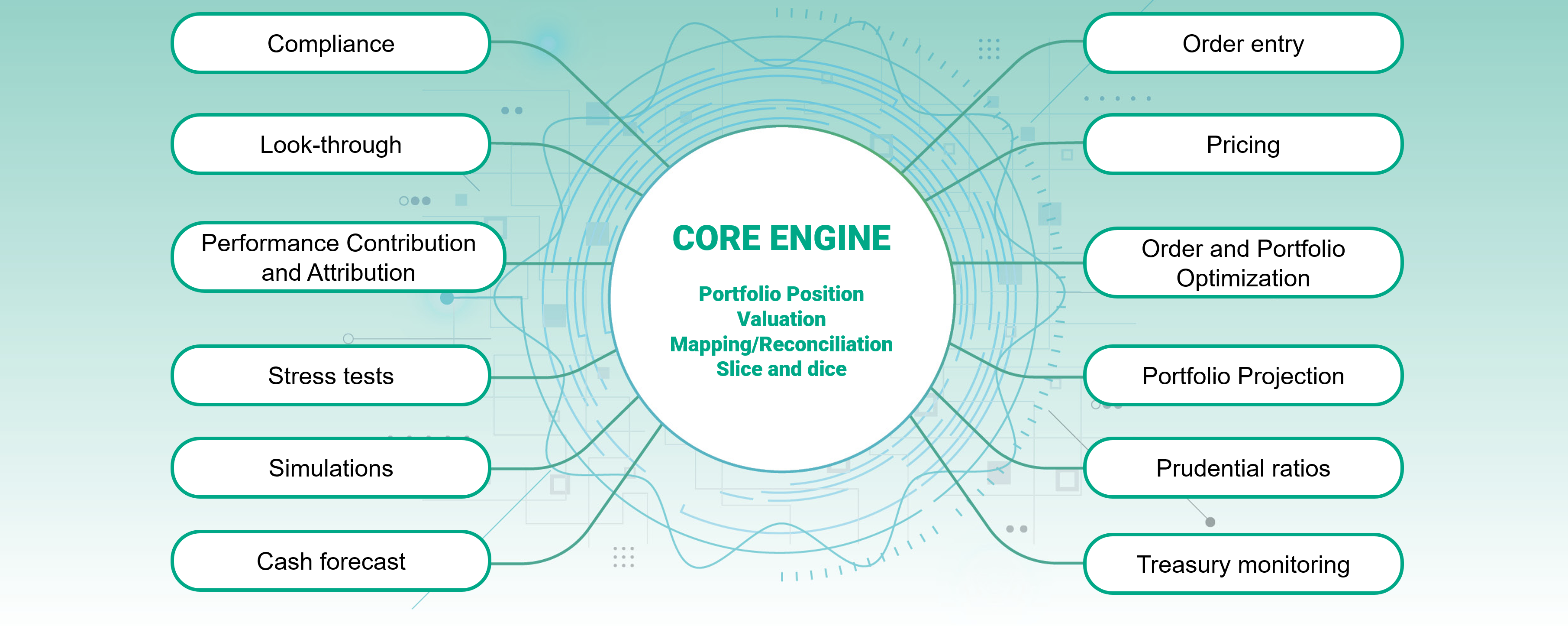
Pricing, exposure, compliance, simulation, stress test, performance attribution: all business building blocks are packaged inside the engine, with their parameters exposed to the portfolio manager. Tailored, because no two teams calculate the same way. And for every number displayed, the calculation detail and the contributing positions are one mouse hover away: end-to-end explainability, from the result back to the source data point.
Three families of business modules
Monitoring & analysis
- Inventory, cash, valuations
- Performance contribution and attribution
- Multi-level look-through
- Customisable multi-axis analysis
- Risk indicators (Treynor, Sharpe, max drawdown)
Decision & operations
- Order entry with customisable workflow
- Order simulation and stress tests
- Constrained quadratic optimisation
- Ex-ante and ex-post compliance
- Forward cash projection
Institutional & risk
- Prudential ratios, market SCR
- Standard and expert pricing (Black-Scholes, Hull-White, etc.)
- Multi-scenario stress tests
- Long-term portfolio projection
- Insurance cash monitoring
For every number displayed, you trace back to the source data, instantly.
Your analyses are either late, or only approximate.
Language: AI inside the same architecture
The Intentional Engine hosts a model-agnostic LLM access layer, and a full agentic layer recently delivered in the product: agents can call the business building blocks above as tools, see the data in context, cite their sources. The portfolio manager asks a question in natural language, and gets a computed, explained, auditable answer, under the same audit trail as the calculations themselves.
Concretely: the agent opens the pricing block (or stress test, or compliance), passes it the parameters read from your question, reads the result computed server-side, and returns it to you in natural language. The numbers and contributing positions remain accessible with a simple mouse hover; the conversation is never disconnected from the calculation.
Use cases
- Automated morning brief on portfolios to watch
- Augmented post-results analysis (P&L vs benchmark, commented)
- Natural language questions on portfolio data
- Extended universe monitoring (weak signals, market events)
Your question in your own words, a computed answer, not an opinion.
End-to-end audit,
one mouse hover away
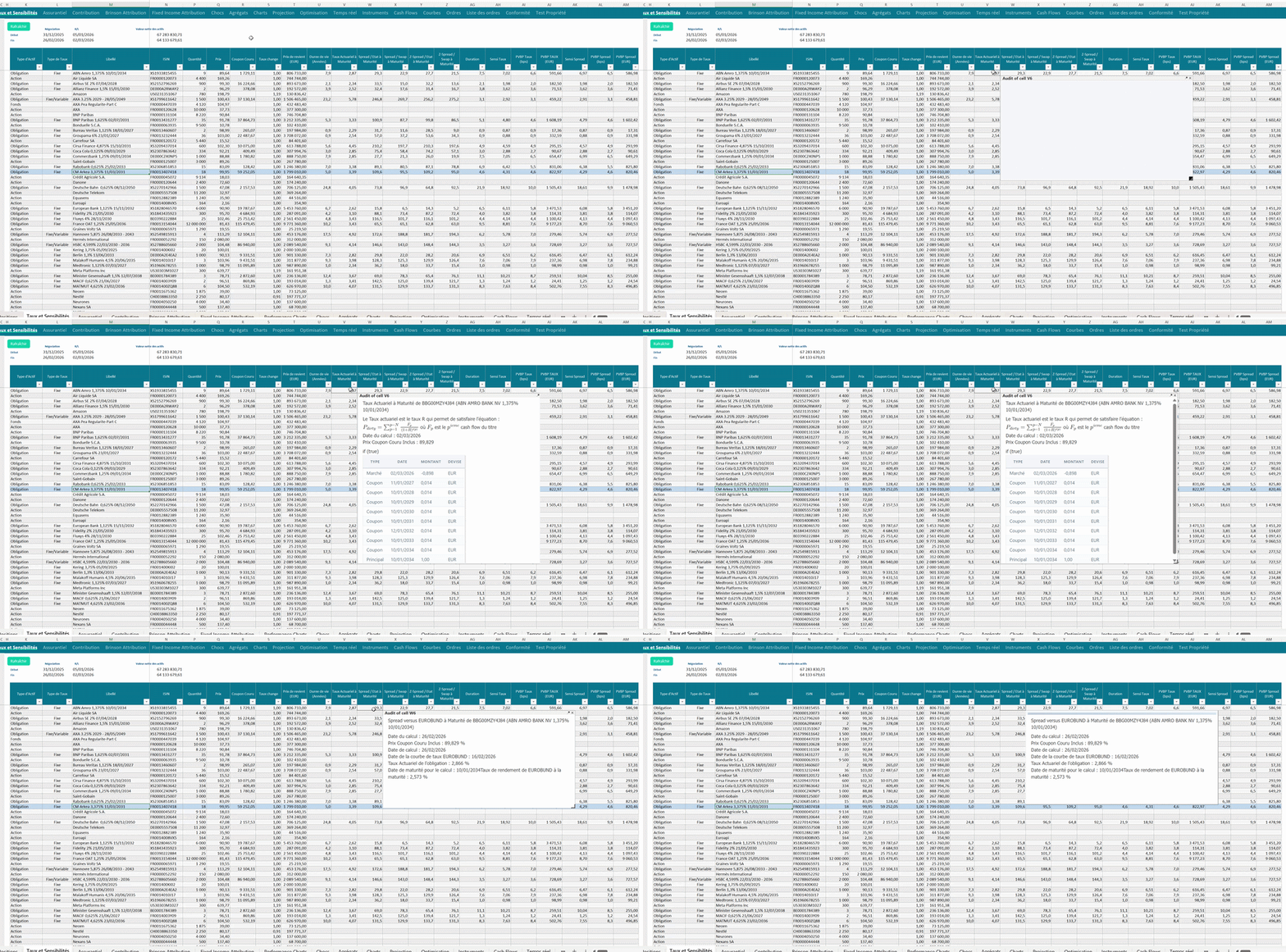
Hover over a cell. See the calculation. Trace it back to the data.
An IRR, a compliance ratio, an exposure calculation: the portfolio manager traces back to the calculation detail and to the contributing position lines, with their valuation. No intermediary, no ticket, no export.
This transparency also applies to your AI agents. When an agent tells you "your SCR exposure is too high", you hover over the response and trace back to the SCR calculation cell, then to the underlying position lines. AI is not a black box: its actions, sources, calculations and justifications stay attached to the same audit trail as the business calculations.
And when an order is placed
Osmoze freezes the full decision context: positions, exposures, evaluated compliance ratios, custom rules applied. A safety memory, for when the question comes back years later: "why did I make that decision on that day?"
How it is possible:
the Intentional Engine
The goal-oriented orchestration engine at the heart of Osmoze, designed before AI, in production since 2012.
Precursor concept
Designed as early as 2006, patented by Heavenize in 2012. The agent / tools / replan orchestration pattern was described thirteen years before the market relabelled it "agentic AI".
Continuity with AI
An architecture designed to plug modern LLMs into the same engine, without reinventing it: they bring the natural interface and reasoning capabilities, the engine keeps control over data, calculations and compliance. AI layer recently delivered in the product, in early commercial rollout.
Production Proof
In continuous production since 2012, at top-10 French asset management and insurance players. Not a POC: an infrastructure proven by volumes, audits and daily use.
The Intentional Engine was ready before AI. That is why the two live in the same architecture here, not out of opportunism, but by design.
The full story of the engine, from patent to the convergence with AI
Native optimisations
Memory-resident calculations, parallelisation, batch processing, differential caching, for industrial response times, even on complex portfolios or multi-scenario stress tests.
End-to-end security & auditability
For every number displayed, the portfolio manager traces back to the calculation detail and the contributing positions, one mouse hover away. The same audit trail applies to the actions, sources, calculations and justifications of the AI agents. When an order is placed, Osmoze freezes the full decision context: a safety memory, for when the question comes back years later.
Excel on the surface, server at the core
The portfolio manager works in Excel, the tool they have known for twenty years. The engine itself runs server-side, with all the power that allows. A web interface, an AI chatbot and APIs round out the setup when the use case requires it.
Operational in as little as 5 weeks
Cloud or on-premise, your choice. Agile and extensible: new views, new calculations, new analysis dimensions, without breakage or disproportionate cost. Internal expertise is industrialised, not lost.
Three approaches to Front Office
tooling
Three ways to think about a portfolio management cockpit, three very different outcomes
| Generalist PMSs | Front Office tools integrated with a data vendor |
Osmoze | |
|---|---|---|---|
| Original orientation | Middle & Back Office | Front Office, trading-oriented | Front Office, portfolio-management oriented |
| Customisation | Bounded by the product's configuration | Within an integrated ecosystem | Total and native |
| Relationship with Excel | Complementary tools, often uncontrolled | Vendor's proprietary interface | Excel on the surface, server at the core |
| AI | Generally still in project phase | Vendor's standard tools | Specialised AI framework, tailored agents |
| Deployment time | Several months to more than a year | Varies with scope | From 5 weeks |
| Extensibility | Tied to the product's releases | Aligned with the vendor's roadmap | Agile and continuous, at your team's pace |
| Data + calculations + language architecture | Disjointed | Depends on the ecosystem | Natively unified |
Generalist PMSs: the Middle Office tool extended to the Front.
Front Office tools integrated with a data vendor: the Front Office tool, inside a proprietary ecosystem.
Osmoze: the Front Office tool, tailored and open.
What scope for your team?
Every Osmoze cockpit is configured for a specific team. Let's talk for 30 minutes about your context, no sales demo, no slides.